Resin
Resin refers to a liquid photopolymer resin that hardens when exposed to UV light. It is most commonly used in the world of 3D printing, where it enables the creation of highly detailed, smooth and precise models with fine contours – far more detailed than typical FDM printing from plastic filaments. Resin materials are used in industry, jewelry, prototyping, model making and by manufacturers of airsoft accessories (e.g., aesthetic parts, mounts, small components). For real firearms, however, resin usually lacks sufficient mechanical strength, unless it is a specialized industrial-grade formula. In short, resin is a high-precision photopolymer material used in 3D printing for detailed and aesthetic prints. There are many types – from standard resins to extremely durable or flexible variants. In airsoft, it is used mainly for accessories and decorative parts, not for components that bear mechanical load. Resin printing requires thorough washing and UV curing, but offers the highest level of detail among all hobby 3D printing technologies.
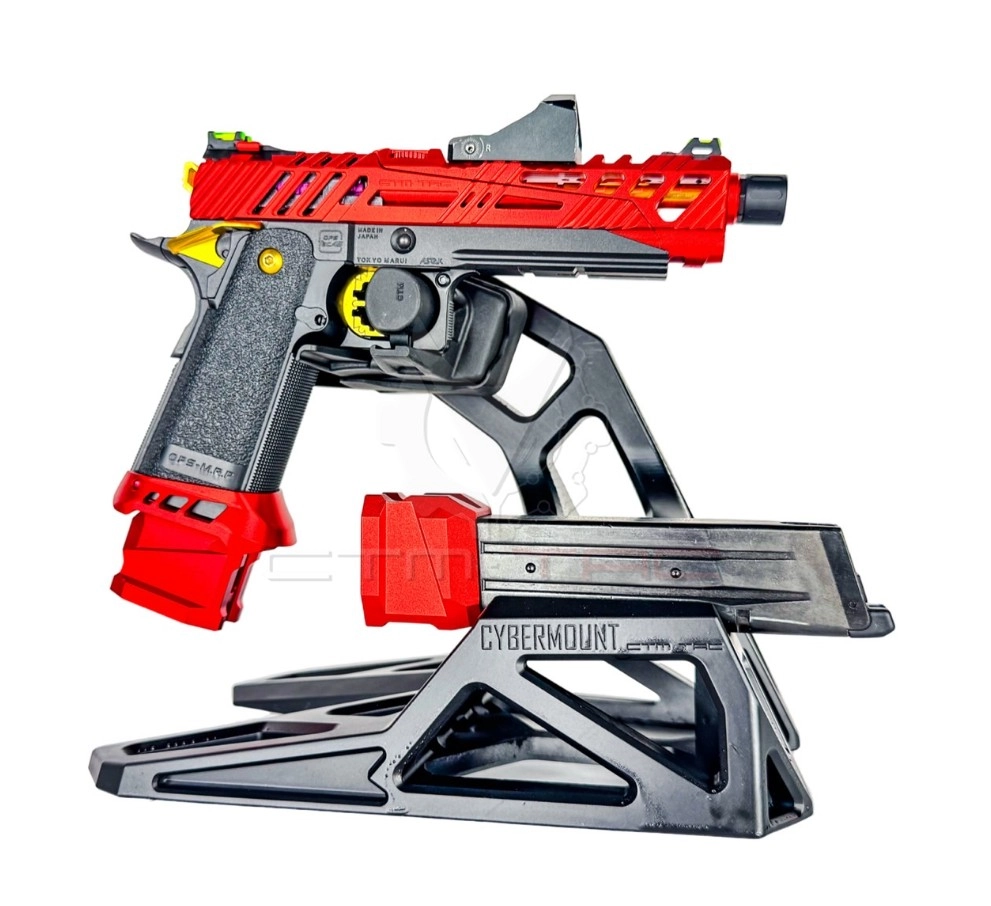
CYBERMOUNT resin stand by CTM TAC for Hi-Capa pistols
Types of resins
- SLA Resin (StereoLithography Resin)
The best-known type – hardens using a UV laser or UV LEDs. Produces very sharp details and a smooth surface. - DLP Resin
Cured using projected digital light. Faster than SLA and often cheaper. - MSLA Resin
Cured via a UV LED panel and an LCD mask – currently the most common technology in hobby resin printers. - Tough / Durable Resin
More flexible and impact-resistant formulas – more suitable for light functional parts. - High-Temp Resin
Withstands high temperatures and is used in industrial settings. - Flexible Resin
A bendable material suitable for soft components or clips. - Dental, Jewelry Resin
Specialized high-precision formulas for extremely detailed prints.
Is resin suitable for airsoft or real firearms?
- Airsoft: Yes, but only for low-stress parts – covers, mounts, decorative components, spacers, dummy parts, small accessory pieces. Some brands like CTM TAC offer resin accessories (e.g., resin stands or aesthetic pieces). Tough resin can be used for lightly functional parts, but it cannot be compared to CNC metal or nylon.
- Real firearms: No – standard resin does not have enough strength or heat resistance. Exceptions include specialized industrial resins and components that are not exposed to recoil or mechanical stress (e.g., training aids).
For functional airsoft parts (hop-up chambers, critical mechanical components, grips, stocks), nylon, polycarbonate or CNC materials are a better choice.
How is resin different from FDM 3D printing?
- Higher precision – resin prints are extremely detailed.
- Smooth surface with no visible layer lines.
- Lower mechanical strength than nylon-based FDM materials (PETG, Nylon, CF). Resins are generally more brittle.
- Requires chemical washing and UV curing.
- FDM materials are better for functional parts, resin is ideal for high-detail models.
Post-processing of resin prints (curing)
Every resin print must go through two steps:
- 1. Washing in IPA (isopropyl alcohol)
Removes uncured resin from the surface. - 2. UV curing
The print is placed in a UV chamber or under a UV lamp – the material then reaches maximum hardness and stops being sticky.
Proper curing is essential – uncured resin is soft and unsafe to touch, while over-cured resin can become brittle.
Powered by Froala Editor