LiHV Battery
LiHV batteries (short for High Voltage Lithium Polymer) are a special type of LiPo batteries that allow higher charging voltage of up to 4.35 V per cell, compared to the standard 4.2 V of regular LiPo cells. For example, a 3S LiHV battery has a fully charged voltage of 13.05 V, while a regular 3S LiPo only reaches 12.6 V. These powerful batteries can also be found in our selection.
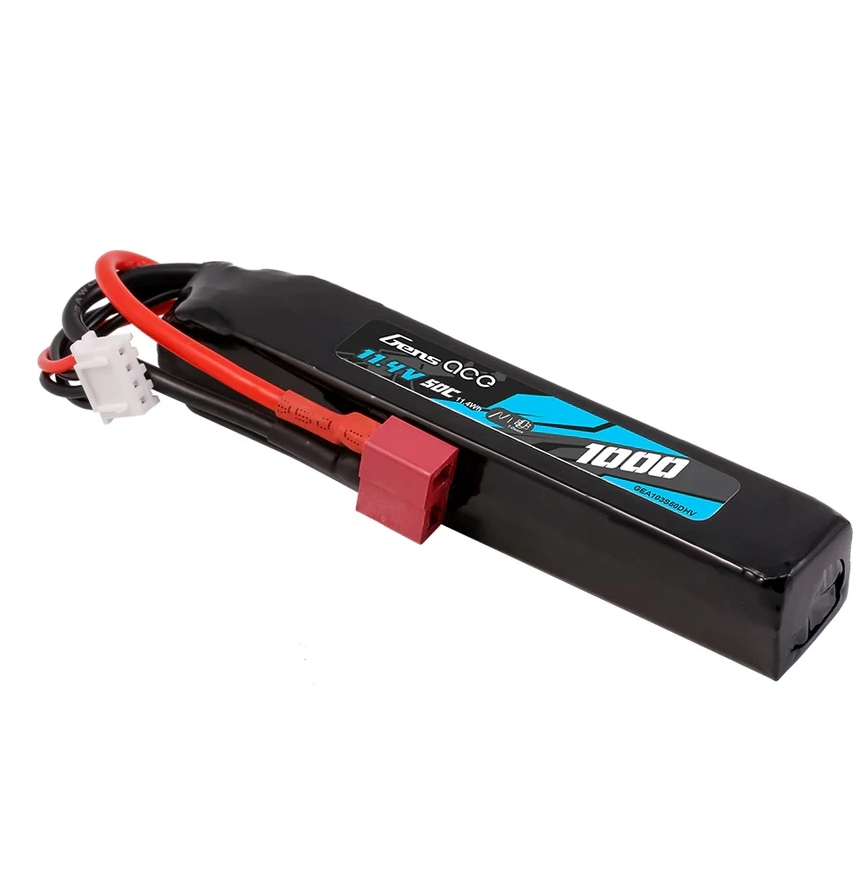
Difference between LiHV and standard LiPo batteries:
- Higher output voltage: LiHV delivers more power, especially faster motor response and higher rate of fire (RoF).
- Requires a special charger: Charging at 4.35 V/cell requires a charger with LiHV mode support for LiPo batteries.
- Compatibility: Can be used in guns designed for LiPo batteries, but only if the electronics and motor can handle higher voltage (ETU units, active brakes, and MOSFETs).
Examples and manufacturers:
- Gens ACE offers several LiHV battery models made specifically for airsoft – such as the LiHV 11.4V 1000mAh or LiHV 1450mAh.
- Redox, Tattu – other well-known brands producing quality LiHV cells.
11.4V vs 11.1V LiPo:
- LiHV 11.4V: Charges to 13.05 V – higher performance, better response, but increased wear on internal components.
- LiPo 11.1V: Charges to 12.6 V – slightly softer power delivery, better suited for everyday use.
Advantages of LiHV batteries:
- Higher performance without needing to switch to 4S batteries.
- Better rate of fire and trigger response – ideal for CQB and Speedsoft.
Disadvantages of LiHV batteries:
- Shorter cell lifespan if frequently charged to maximum voltage.
- Increased wear on motor, trigger, and gears – recommended to use with MOSFET or ETU systems.
- Requires compatible charger (e.g. Gens Ace iMars, Redox Delta). Standard LiPo chargers won’t fully charge LiHV cells.
Powered by Froala Editor