3D Print
3D printing (additive manufacturing) is a technology in which a three-dimensional object is created by gradually layering material according to a digital model. Unlike traditional machining (material removal), 3D printing adds material only where it is needed, enabling rapid production of complex shapes, prototypes, and functional parts. The origin of 3D printing dates back to 1986, when Chuck Hull patented the SLA (stereolithography) technology and founded the company 3D Systems. Over time, additional technologies emerged (FDM, SLS, DLP), which today form the foundation of modern additive manufacturing. 3D printing is therefore a modern manufacturing technology that enables fast and flexible production of complex parts from plastics, resins, and metals. It is used in industry, as well as in the military and airsoft, where it allows custom accessories and rapid prototyping. Although it does not replace CNC machining for highly stressed parts, it has become an indispensable tool of modern manufacturing. 3D conversion kits from SRU can also be found on our e-shop.

Basic 3D printing technologies
- FDM / FFF – printing from plastic filament, the most widespread technology.
- SLA / DLP / MSLA – printing from liquid resin using UV light, extremely detailed.
- SLS – powder sintering (nylon), industrial use.
- DMLS / SLM – printing from metal powder (steel, aluminum, titanium).
Materials used in 3D printing
The materials used differ significantly in properties and applications:
- PLA – easy to print, low strength and heat resistance; suitable for prototypes.
- PETG – higher durability, more flexible, moisture-resistant.
- ABS – higher heat resistance, tough, more demanding to print.
- Nylon (PA) – very strong and durable, ideal for functional parts.
- Carbon / Glass Fiber – nylon reinforced with carbon or glass fibers.
- Resin – extreme detail, smooth surface, lower mechanical resistance.
- Metal powders – steel, aluminum, titanium (industry, military).
Use of 3D printing in the military
Armies around the world primarily use 3D printing for:
- rapid production of spare parts in the field,
- prototyping of gear and weapon accessories,
- production of custom ergonomic components,
- training aids and mock-ups,
- light mounts, adapters, and covers.
3D printing significantly shortens logistics chains and enables immediate production without waiting for deliveries.
3D printing in airsoft
In airsoft, 3D printing is extremely popular thanks to the possibility of customization and sci-fi weapon builds:
- stocks, grips, handguards,
- optic and camera mounts,
- weapon stands,
- holsters and mounts,
- aesthetic accessories (cyberpunk style).
For functional parts, nylon or filaments reinforced with glass/carbon fiber are mainly used, while resin is better suited for detailed and design-oriented parts.
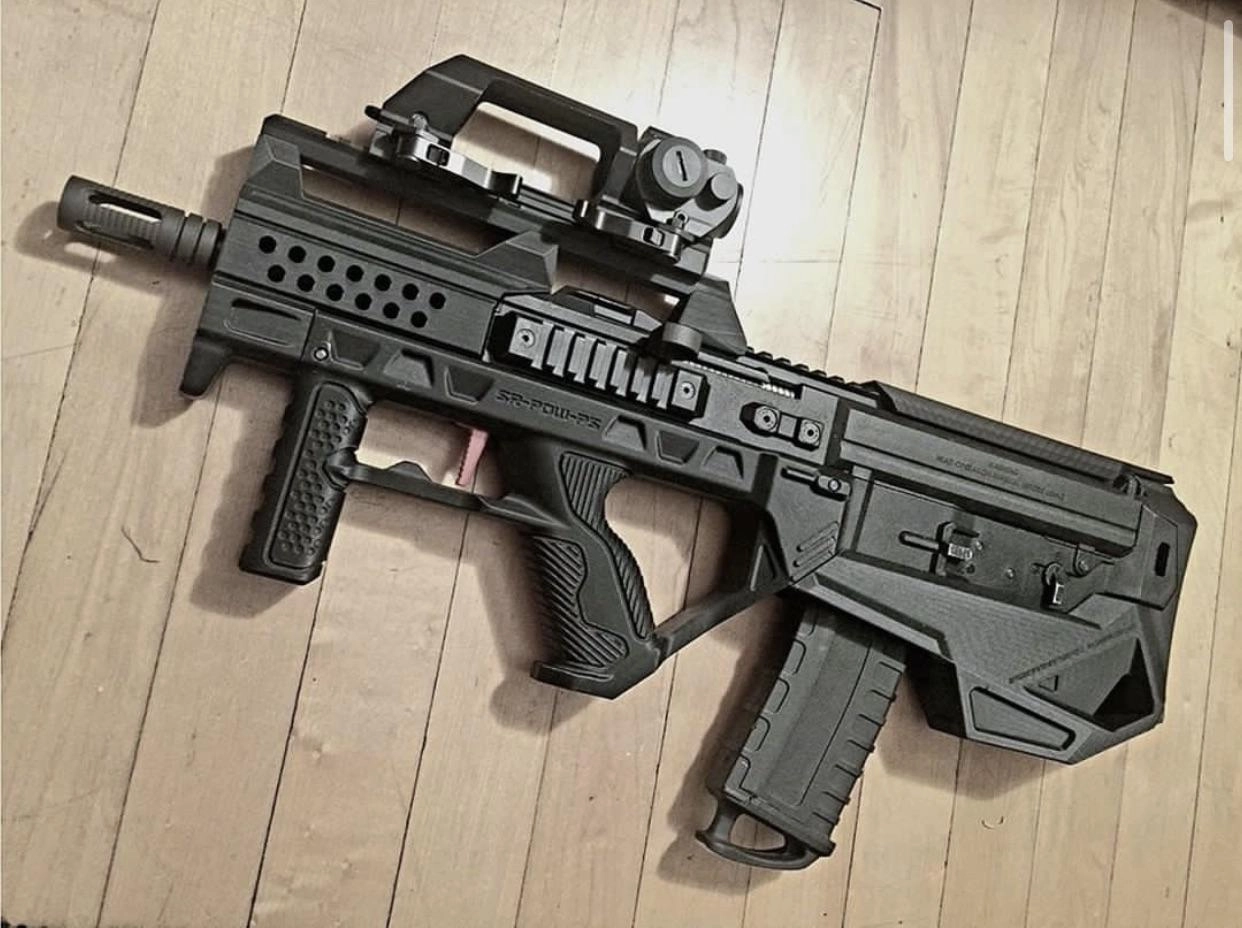
Airsoft 3D conversions by SRU (also available on our e-shop)
Advantages and disadvantages of 3D printing
Advantages:
- rapid prototyping,
- low costs for small-batch production,
- virtually unlimited geometry,
- high level of customization.
Disadvantages:
- lower strength compared to CNC metal parts,
- limited lifespan for highly stressed components,
- dependence on material and print quality.
Powered by Froala Editor