Fabric Grammage
Fabric weight is a parameter that specifies the mass of a textile material per unit area, most commonly expressed in g/m² (grams per square meter). It is one of the most important technical characteristics of clothing, as it directly affects durability, warmth, breathability, service life, and wearing comfort. Fabric weight is therefore a key technical value that determines the weight, durability, and functional properties of garments. In military and professional outdoor clothing, it helps to choose the right layer according to role, weather conditions, and physical load. The goal is not to have the heaviest possible material, but the correct fabric weight for a specific use.
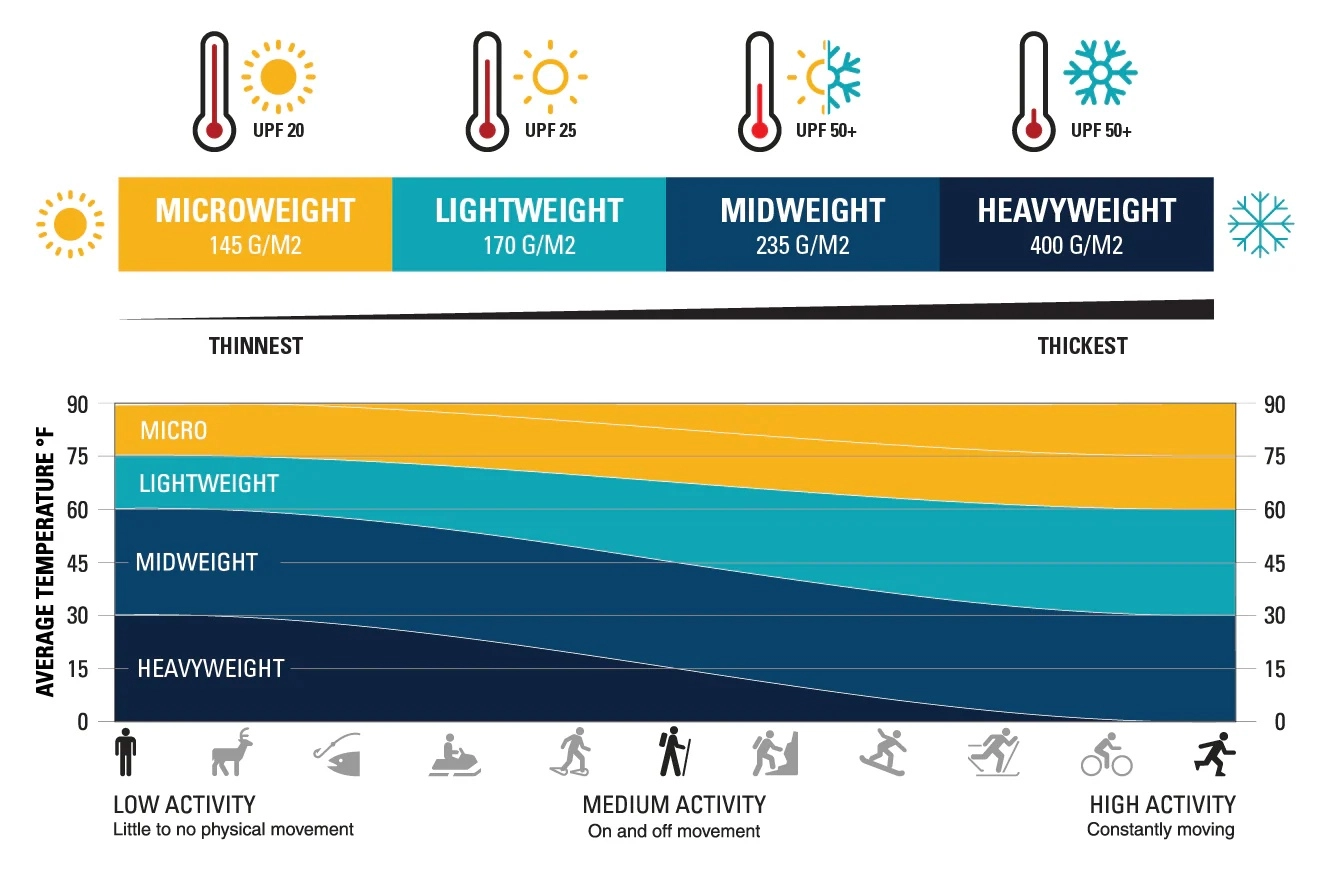
Example of different fabric weights depending on activity type and outdoor temperature (3 °F = 1 °C)
Why fabric weight is important in military clothing
In military, tactical, and professional outdoor clothing, fabric weight plays a crucial role because it defines the balance between protection and mobility. A soldier or operator must:
- remain protected against cold, wind, and mechanical wear,
- avoid unnecessary load from excessive garment weight,
- maintain effective moisture management during prolonged activity.
A properly chosen fabric weight is therefore essential for long-term performance, endurance, and comfort.
Typical fabric weights by clothing layers
Base layer
- approximately 120–180 g/m²
- lightweight, fast-drying, designed for moisture wicking
Mid layer – fleece / light insulation
- approximately 180–300 g/m²
- thermal insulation while maintaining breathability
Softshell
- approximately 250–400 g/m²
- wind protection, mechanical durability, flexibility
Hardshell (membrane jackets)
- approximately 350–600 g/m² (depending on construction)
- maximum protection against rain and wind
Insulated jackets (synthetic / down)
- typically evaluated by insulation weight (e.g. 60 g, 100 g, 200 g)
- intended for cold to extreme conditions
Difference between civilian and military / professional clothing
Civilian clothing
- often lower fabric weight for comfort and price,
- less emphasis on mechanical durability,
- shorter service life under intensive use.
Military and professional outdoor clothing
- higher or precisely targeted fabric weight depending on the layer,
- resistance to abrasion, tearing, and long-term stress,
- optimization of weight versus protection,
- tested in real-world conditions.
Common misconception: higher fabric weight = better clothing
A higher fabric weight does not automatically mean a better material. Modern military and outdoor textiles often use:
- advanced fabric weaves,
- synthetic fibers with higher strength,
- laminations and membranes.
Thanks to this, a material can have a lower fabric weight but higher durability than a heavy civilian fabric.
Powered by Froala Editor